
Taming Olga
Do your goals ever turn into just another excuse to feel not-good-enough?
Even “healing” goals. Even “growth” goals. Even “health” goals. The ones that are meant to be good for you can give your Inner Critic a sneaky invitation to take over.
You encounter a person who always rubs you up the wrong way. You find yourself irritated and impatient, and you wonder, “why can’t I handle this better?”
You sign up to learn a new skill. You hate your first effort, and then feel silly for being disappointed and embarrassed.
You’re working on eating more protein to preserve your muscle mass. You have a day where you eat more potatoes than chicken breast, and you berate yourself for “not being healthy”.
We so often go to battle against ourselves. It’s as though we believe we need a watchful, suspicious taskmistress monitoring our every move and keeping us on the straight and narrow. Let’s call her Olga.

Hello Olga
Olga is just part of our operating system. Your version will have her own flavour based on your experiences, but they all serve the same function. Olga is designed to keep us safe through constant vigilance, detecting anything out of the ordinary and pulling us back into conformity. Olga is hardwired into our nervous system and she is working as intended.
It helps to know a little about how she works. Olga hangs out in the sensing part of your brain that scans for threats. She moves fast and is not very discerning. She receives signals from the environment and fires up a response before your thinking mind has caught up — she doesn’t know whether it’s a butterfly or a mosquito that has landed on your arm before she tells you to swat it away. And she knows how to hold a grudge — she will hold on to that one harsh comment and totally ignore the five kind ones.
Olga will try to convince you that
– If you were talented enough, you’d be able to do it well the first time
– If you were disciplined enough, you would be 100% consistent
– If you were smart enough, you would already understand
– If you just work a bit harder, you would have the success you crave
– If you chose better people around you, they would never let you down
And here’s the kicker: our body responds to Olga’s shit-talking in just the same way as we react to a mean schoolkid. Your body reacts the same whether it’s an internal or external threat: heart racing, shallow fast breathing, tightening in your chest or jaw.

Panic stations…
Can we avoid Olga?
It can be really tempting to try to avoid ever experiencing a visit from Olga. When we have this project, we try to reduce uncertainty. This can really shrink our worlds, and create a lot of tension in our relationships.
If you aspire to keep putting yourself in the path of learning, growth and self-reflection, then you are venturing into core Olga territory — the land of uncertainty, unfamiliarity, unpredictability, and uncomfortable emotions.
Even pursuits like journaling, meditation, and healing from trauma can trigger Olga to tell you how you are not doing it right.
Learning is, by definition, venturing into the unknown. It means prediction errors, mismatches, shitty first drafts, and falling short. Every time you move into the learning zone, Olga will try to march you back to the safety of your old normal. The very things you are reaching for are the things that set her off. Olga will tell you that if you were just a bit better, you wouldn’t ever have to have a difficult experience.
Olga v Change
Once we have identified something that we want to change, we want to get there Right Now. We want to be able to apply our big brains, figure it out, and execute a solution with perfect accuracy and discipline. Flip a switch and leap into the New Normal. Even if we know that this isn’t the reality of how change happens, we still all want to skip over the discomfort of learning.
Let’s be honest — we’d all like to avoid having to deal with Olga. I get it.
And what helps is counter-intuitive.
It’s making space for the experience that you are having right now. The awareness that you want things to be different, and the cost of staying where you are. The wanting, but not yet having. The thoughts and feelings that go with the awareness of, I’ve been acting in ways that are out of line with what I know is best for me.
The reason we usually avoid this awareness is that our Olga voice can get really loud. She thinks you shouldn’t have difficult thoughts and feelings, and that it’s all your fault. She’d like to tell you all the ways that you could have avoided having this experience if you just were a bit better …
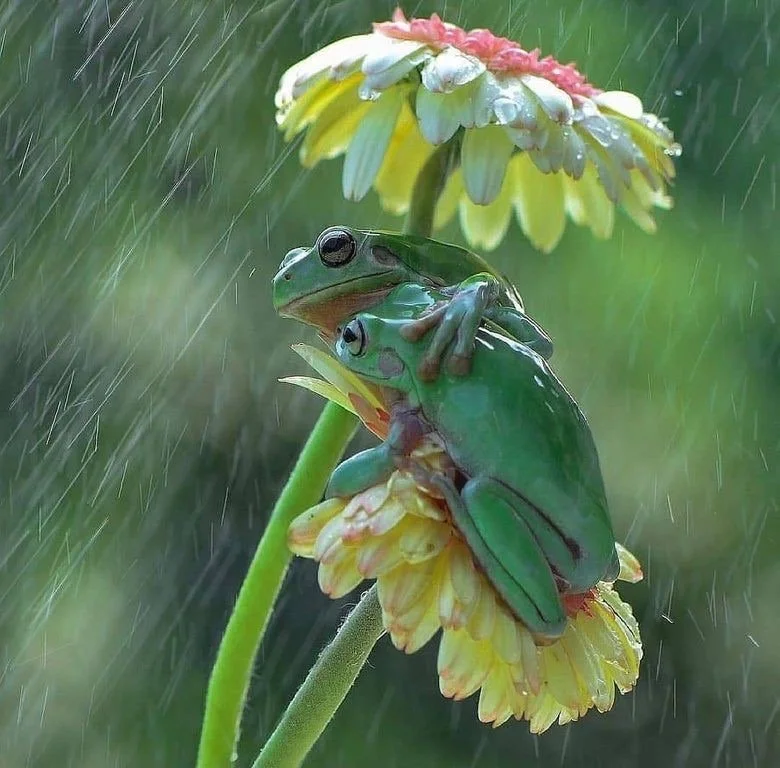
Treat Olga like a tender friend
Meeting Olga with compassion
If we are courting uncertainty and change, we need a strategy for when Olga inevitably comes to visit. Shouting her down, avoiding her, or trying to keep the door locked just doesn’t work. But there is a way to turn down the volume and bring Olga along for the ride. It’s compassion.
The recipe for compassion is awareness plus warm acceptance. What’s Olga telling you? What’s the feeling there? Acknowledge that inner voice and send yourself warm understanding. If it’s tough to muster up some compassion for yourself in that moment, try thinking about someone you love telling you what their inner Olga was saying. How would you feel toward the person having that experience? What is the kindest thing you would say?
Compassion triggers a feeling of safety. A feeling of, I can tolerate this after all. A relief from shame. And paradoxically, allowing Olga to hang around while creating that pause of kindness, helps Olga relax and put her feet up.
That compassionate pause — just noticing what is actually happening rather than rushing to fix it — turns the neuroscience to our favour.
The same nervous system that detects threats and triggers Olga also has a system for safety and soothing. It switches on when we are cared for, held, reassured. It runs on slow breath, warm contact, a kind tone. And it responds whether that care comes from someone else or from you. Self-compassion is a way of telling your body, in a language it understands, that you are safe. That this challenge is within your ability to manage. That these feelings are understandable. The thinking and deciding can come after, once your inner Olga has taken a back seat. Let your body hear it’s safe first.
Over time, what builds is a new tolerance for the inevitable difficult thoughts and feelings that come with any real growth. The missteps still happen, the disappointment and the maybe I should have done it differently. But it no longer has to derail you. It’s faster to get back on track, and you have more and more of a sense of being on your own side. And that is what helps us to keep going instead of collapsing, avoiding, or fleeing.
The sweet spot
There is a place I am aiming for. It sits between toxic positivity — the insistence that everything is delightful, that nothing bothers us — and cynical nihilism — nothing is going to go right, so why bother trying.
In that place you can say: this hurt. I wanted more from myself than I managed today. And I am still on my own side — a place where “I am OK” and “I am growing” can co-exist.
Two practices
Next time you catch Olga mid-lecture, try these. Don’t argue with her. Don’t obey her either.
Notice the body. Olga arrives in the body before she arrives in words, so that is where the pause begins. Feel your feet on the floor. Let your eyes rest on one ordinary thing — a cup, a window, a plant. This tells the old, fast part of your brain what it most wants to know: there is no tiger. Then place a hand somewhere that feels supportive — over your heart, on your cheek, your other forearm — and let the weight of it register. Breathe out longer than you breathe in, three or four times. Notice where Olga lives in you right now — the jaw, the chest, the shoulders — and let that place be there without doing anything about it.
Notice the mind. “Olga is here”. Name what actually happened, in plain words, with no verdict attached. Then say one true, kind thing to yourself, to acknowledge the tenderness and difficulty — something you would say to a friend.
Words offered to a body that is still braced don’t land. But primed with safety, the kindness can seep in.
And once you’ve quieted your inner Olga, you can return to the learning.
An invitation
Have a play and let me know how you go!
And if your “Olga” is getting in the way of the life you’re wanting for yourself, that’s the kind of thing people bring to coaching.
Coaching is where we slow down enough to notice what is actually happening, and practise being on your own side while you grow. If you are curious what that could look like for you, I would love to hear from you.
xx Heather
